UK wildfire operations
Specialist Wildfire Support
CritiCall provides specialist fire, rescue and operational resources for wildfire risk, remote land operations, planned standby, controlled land-management activity and extended incidents across the UK.
Off-road firefighting, remote access, command, communications and specialist vehicles are brought together around the terrain, hazards and practical demands of the task.
At a glance
Wildfire capability
Off-Road Response
4x4 and Tracked Vehicles
Water Movement
Command and Control
Temporary Communications
Extended Operations
Aerial Support Coordination
Fire-ground resources
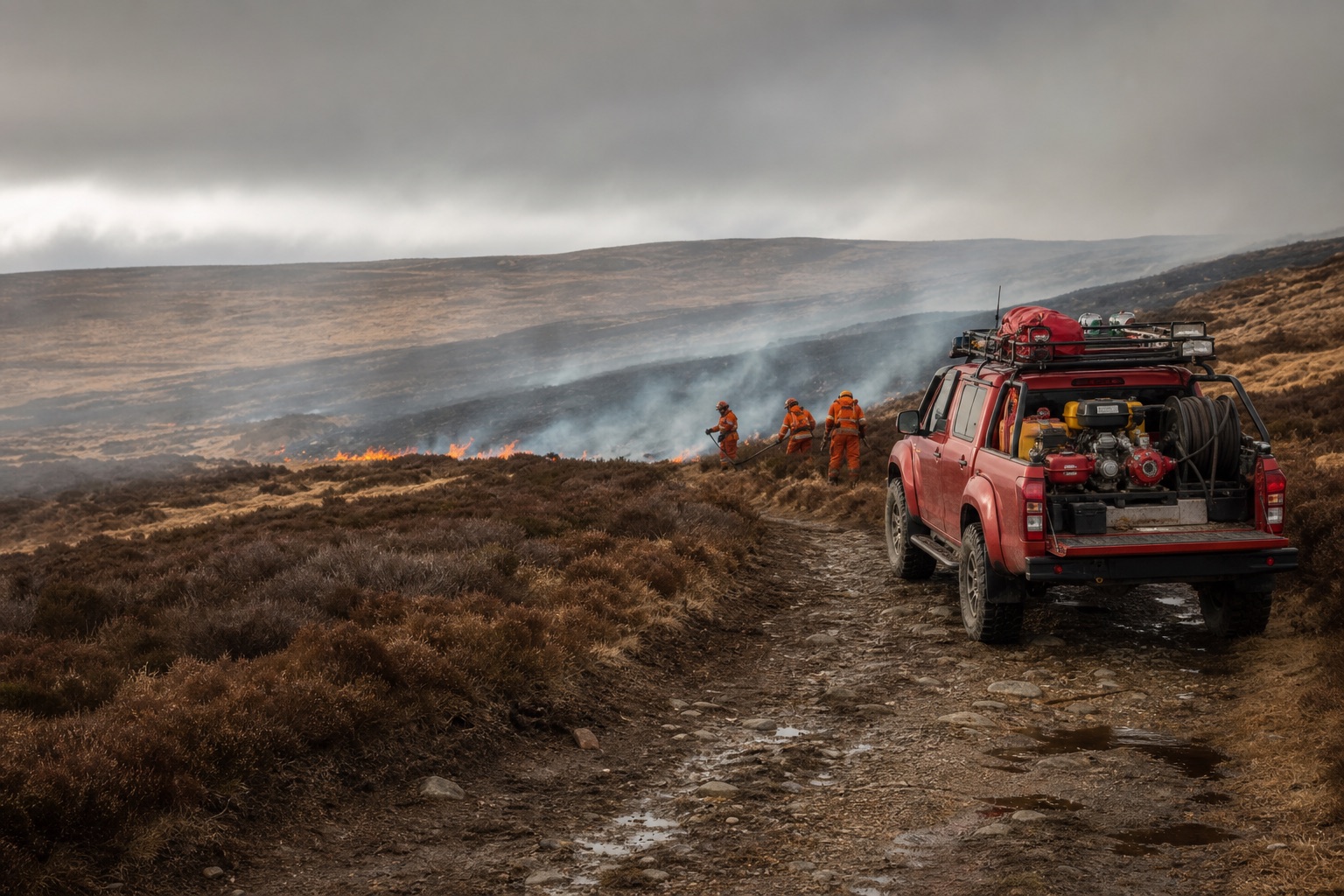
Wildfire Fire & Rescue Support
Wildfire work demands people, equipment and access methods selected for the ground rather than a conventional road-based response.
CritiCall can provide crews for defined wildfire tasks, including periods of heightened-risk standby, active fire-ground assistance, remote firefighting, patrol and mop-up. At the fire edge, personnel can work with hand tools, beaters, hose and portable pumping resources suited to the vegetation, terrain and role confirmed by the client.
As the incident moves from active suppression into containment, crews can patrol affected ground, identify and extinguish hotspots, reinforce control lines and continue observing sectors where heat remains. The same practical approach can provide fire cover during contracted land-management burns when the activity is appropriately controlled.
Resources are matched to access, water availability, expected fire behaviour and the working period. CritiCall integrates with the client’s incident structure so priorities, communications and escalation routes remain clear throughout the deployment.
Mobility over difficult ground
Take People and Equipment Beyond Normal Road Access
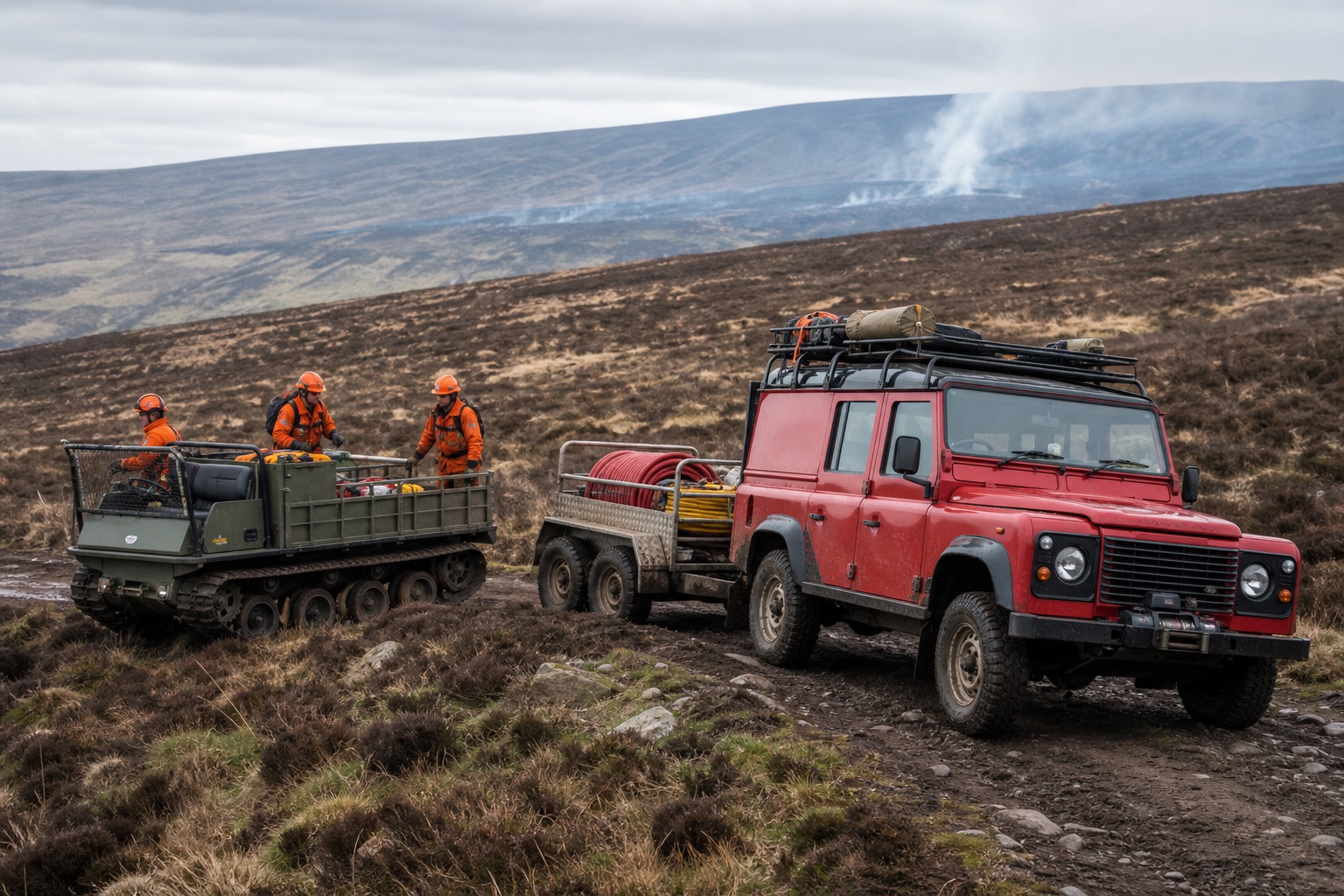
Moorland, heathland and woodland fires rarely remain close to a surfaced road. Rough tracks, steep gradients, soft ground and restricted estate access can separate crews from the equipment, hose and water they need.
CritiCall can use appropriate 4x4 Land Rovers, tracked or low-ground-pressure carriers and other selected off-road resources where they suit the confirmed task. These vehicles move personnel, hose, portable pumps, hand tools and firefighting equipment between access points and remote sectors without depending on a conventional appliance reaching the fire edge.
Mobility also supports the wider fire-ground. Crews can be transferred as priorities change, equipment can be recovered for replacement or repair, and remote teams can receive water, fuel and essential supplies. Vehicle choice remains grounded in route condition, load, terrain and landowner constraints rather than being treated as a generic fleet package.
- 4x4 response vehicles
- Tracked or low-ground-pressure access
- Remote crew movement
- Wildfire misting units where selected
- Equipment transport
- Off-road pumping resources
Remote supply
Move Water and Equipment Into Remote Fire Sectors
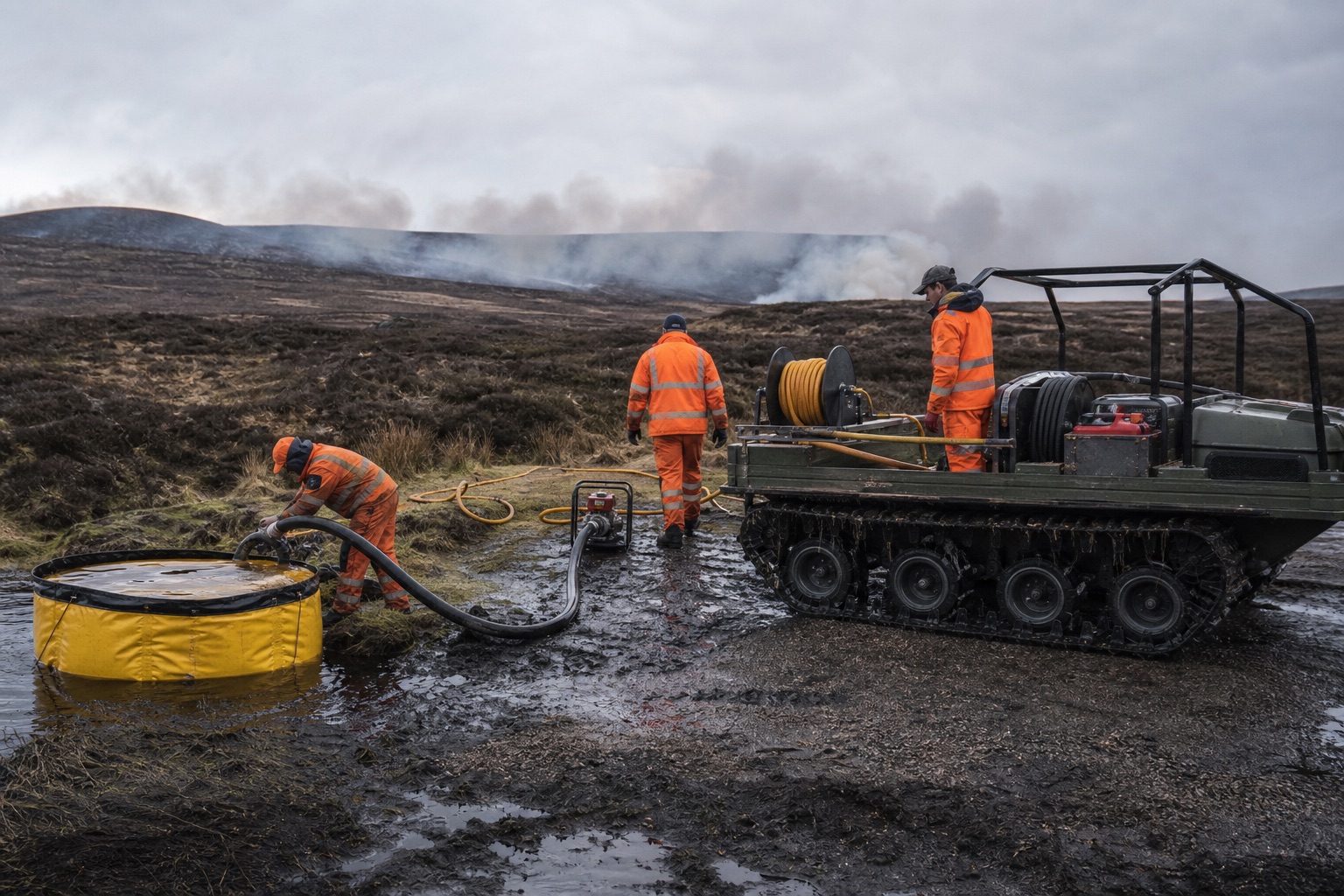
Water at an accessible road or hardstanding is only useful if it can be moved to the crews who need it. CritiCall can establish portable pumping, hose relay and temporary water-point arrangements that bridge the distance between refill locations and remote fire sectors.
The delivery method is shaped around elevation, hose distance, track access, available supplies and the rate at which firefighting resources need to be replenished. Off-road vehicles can move pumps, hose, fittings and equipment while refill coordination keeps shuttles and remote crews working to a shared resupply plan.
During extended incidents, the same logistics function supports equipment transport, replacement hose, fuel, lighting and essential consumables. This reduces avoidable journeys by fire-ground personnel and keeps scarce off-road access routes organised.
- Portable pumps
- Hose relay
- Temporary water points
- Off-road water movement
- Refill coordination
- Equipment transport
- Remote resupply
- Extended-duration logistics
A practical base close to the task
Create a Forward Base for Command, Coordination and Welfare
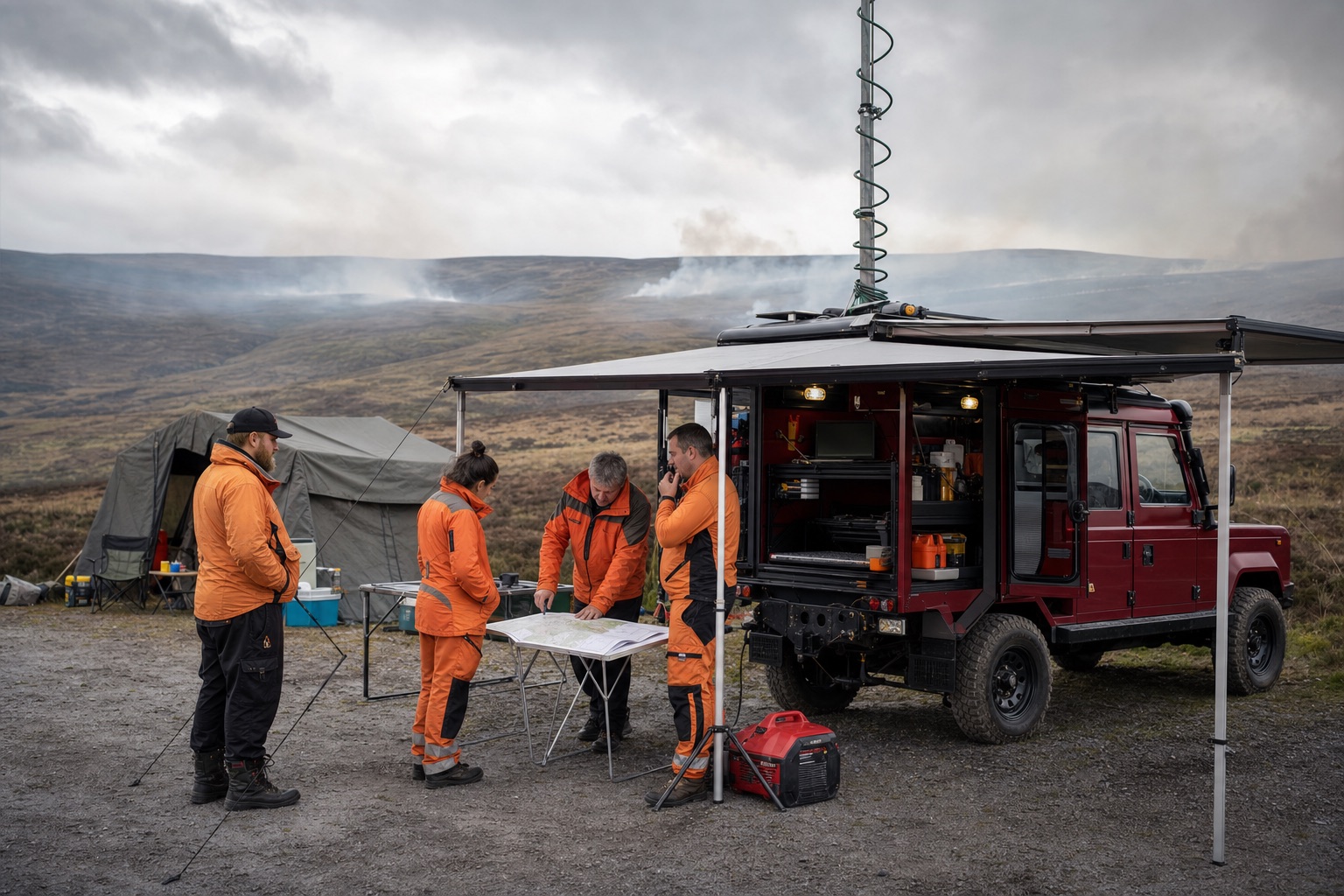
A temporary forward base gives a dispersed wildfire deployment somewhere to brief, communicate, record decisions and coordinate resources. CritiCall can provide contracted command and coordination facilities around the needs of the client’s incident structure.
Command vehicles and temporary work areas can accommodate mapping, incident logging, information management, radio traffic and liaison. Power generation, shelter and lighting allow the base to remain useful beyond daylight, while welfare space supports rest, hydration and rehabilitation between working periods.
The facility is scalable. A short standby may need a compact briefing and communications point; an extended incident can require shift handovers, resource tracking, charging, equipment storage and structured welfare. CritiCall does not assume authority over statutory responders: the service provides facilities, personnel and coordination within the role agreed for the task.
- Command vehicle facilities
- Mapping and logging
- Operational briefings
- Power and lighting
- Shelter and welfare
- Liaison support
Keep remote teams connected
Maintain Communications Across Distance and Difficult Ground
Wildfire crews may be separated by ridges, woodland, distance and changing vehicle access. A temporary radio network can maintain contact between remote teams, sector contacts and the forward base when ordinary site communications are insufficient.
CritiCall can configure radios, deploy repeaters at useful locations and provide control-room communications for the agreed deployment. The network can follow changing operating locations and give dispersed teams a consistent route for priority messages, welfare checks, resource requests and updates from command.
Communications are treated as part of the fire-ground rather than a standalone equipment hire. Channel plans, call signs, briefing and logging are integrated with the incident structure so radio traffic remains understandable during a changing operation.
Rotary-wing wildfire operations
Support Aerial Firefighting Helicopter Operations
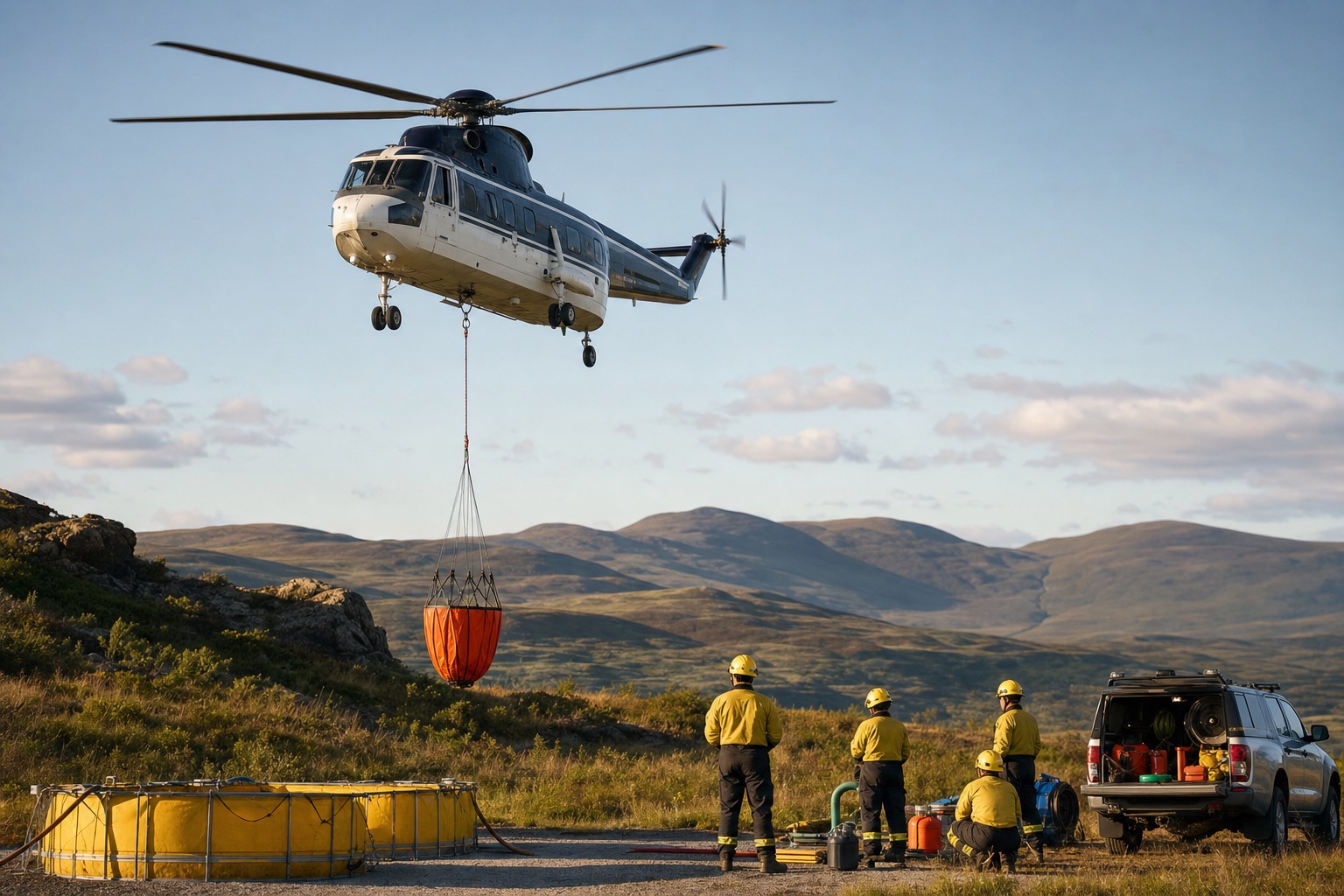
Helicopters using Bambi buckets can add reach and water delivery to a wildfire operation, but repeated aircraft movements also create a demanding ground-side task. CritiCall can support temporary forward operating locations with standby ARFF, fire cover at refuelling points and practical control of access around the landing area.
Ground arrangements consider sterile areas, rotor wash, emergency access, communications and the movement of crews or vehicles near the aircraft. The service can follow authorised changes in operating location and remain available across repeated landing, departure and refuelling cycles during an extended flying period.
Coordination with the relevant incident structure and ground crews helps connect aircraft movements with the wider wildfire operation. CritiCall does not operate the aircraft or direct flight activity; flying decisions remain with the appointed aviation operator and flight crew.
Endurance and continuity
Sustain Wildfire Operations Beyond the Immediate Fire Front
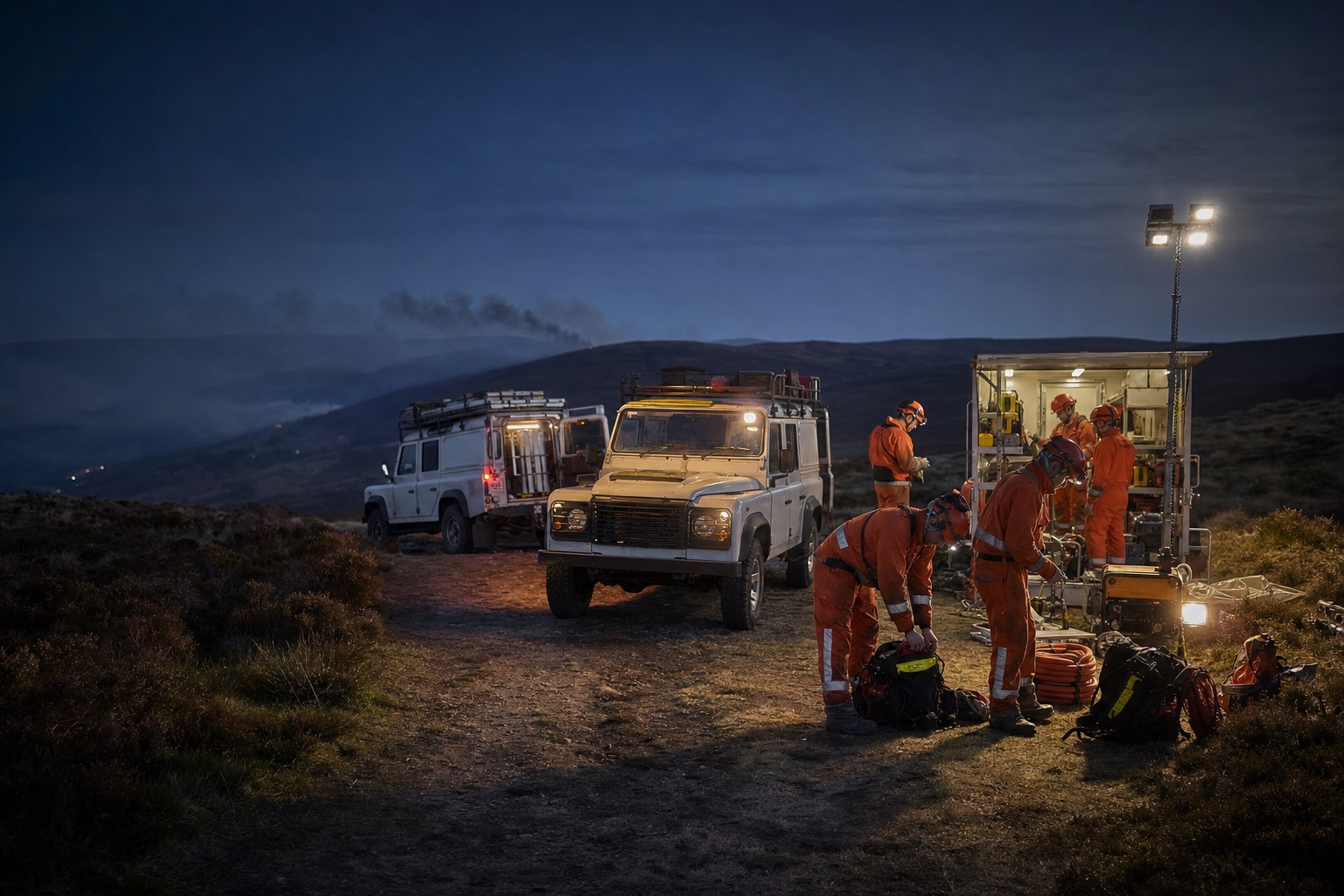
An incident that continues into the night or across several operating periods places different demands on people and equipment. Crew rotation, lighting, water, fuel, communications, equipment replacement and information handover all need attention if readiness is to be maintained.
CritiCall can scale welfare, logistics and forward-base resources around the expected duration. Rest and rehabilitation areas, charging and lighting, structured resupply and replacement equipment allow crews to prepare for the next task without losing contact with the current fire-ground picture.
Weather, access and fire behaviour can alter the resource need between periods. The service is reviewed as the task develops, avoiding claims of unlimited endurance while giving the client a practical route to sustain the agreed deployment.
- Crew rotation
- Night lighting
- Water and fuel resupply
- Equipment replacement
- Welfare and rehabilitation
- Operational handover
Shared situational awareness
Maintain Continuity as Conditions and Personnel Change
Wildfire information changes with the wind, vegetation, access and progress at the fire edge. A structured handover prevents the next working period from having to reconstruct the incident picture from fragments.
CritiCall can maintain incident logs, mapping updates, sector information, communications plans and resource records within the contracted role. Briefings bring those elements together for incoming personnel, including known hazards, water and access information, current priorities and changes in weather or fire behaviour.
This is a practical fire-ground function rather than an office exercise. Its purpose is to help crews, vehicle operators, communications personnel and the client’s incident team work from the same current information as people and conditions change.
- Structured briefings and handovers
- Incident and decision logging
- Mapping and sector updates
- Communications plans
- Resource tracking
- Weather, fire and access changes
Where we support
Wildfire Environments and Operations We Support
Moorland
Resources for remote fire sectors, difficult access and extended hose or water movement.
Heathland
Off-road fire and logistical provision across dry, open vegetation and changing fire edges.
Woodland
Delivery shaped around restricted access, tree cover, track condition and remote firefighting.
Rural estates
Standby, land-management activity and defined wildfire response roles for rural sites.
Land-management burns
Fire cover and specialist resources for contracted activity that is appropriately controlled.
High-risk weather periods
Pre-arranged standby during periods when weather and vegetation elevate wildfire risk.
Remote infrastructure
Wildfire provision around utilities, construction, communications and exposed rural sites.
Wildfire exercises
Vehicles, crews, command facilities and communications for realistic training scenarios.
Aerial firefighting operations
Ground-side fire and safety resources for Bambi bucket helicopter activity.
From scope to stand-down
How CritiCall Delivers Wildfire Support
- 01Initial discussion
- 02Site and risk information
- 03Resource and access planning
- 04Team briefing
- 05Deployment and live support
- 06Stand-down and review
Resources shaped around the ground
Why Choose CritiCall for Wildfire Support?
Wildfire support is not a standard event-fire package. Each deployment must reflect the terrain, access, water, fire behaviour, weather, operating period and resources already in place.
CritiCall brings fire-ground personnel, off-road mobility, remote logistics, command facilities and communications together as one coherent service. The client can define a focused standby role or combine resources for a more sustained deployment without forcing unrelated group services into the scope.
The approach is practical: establish how crews will reach the task, how water and equipment will move, how dispersed teams will communicate and how the deployment will remain supported if conditions or personnel change.
- Specialist wildfire capability
- Off-road vehicles and equipment
- Remote-access experience
- Integrated command and communications
- Support for extended operations
- Aerial firefighting ground support
CritiCall is an independent specialist provider and does not replace statutory fire and rescue services or mobilise automatically to public wildfire incidents.
Request a quote
Planning Wildfire Support?
Share the location, dates, terrain, known risks, access constraints and support requirement. CritiCall will work with you to define the wildfire crews, vehicles, command, communications and logistical resources needed for the task.